
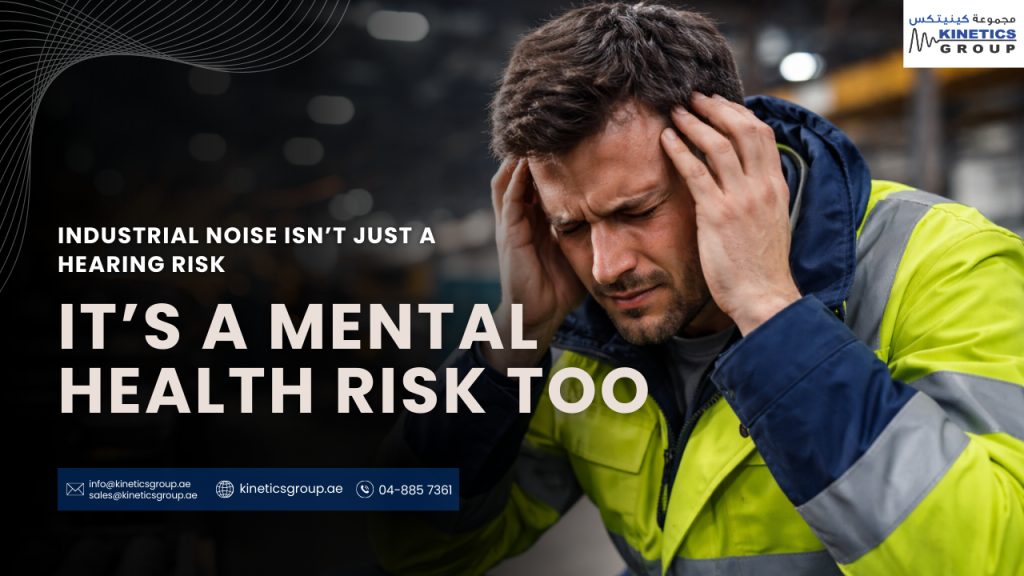
At Kinetics Group, we’ve always treated industrial noise as more than a “decibel problem.” Yes, noise can damage hearing — but in real factories, noise also drains focus, elevates tension, disrupts recovery, and quietly pushes people toward burnout.
A recent manufacturing-industry study from Indonesia makes that message uncomfortably clear: workplace noise isn’t only an audiological hazard. It behaves like a psychosocial stressor that measurably increases work stress and psychological distress.
What the Research Found (And Why It Matters)
In a cross-sectional study of 212 workers from a metal manufacturing environment, researchers measured daily noise exposure using a time-weighted average (TWA) method aligned with ISO 9612:2009, and assessed worker outcomes using validated tools: the Job Stress Scale (JSS) and the GHQ-12 mental health screening questionnaire.
The workplace reality was familiar to anyone who has walked a production floor:
- 43.4% of workers were exposed to 85–90 dB (moderate noise)
- 29.2% were exposed to >90 dB (high noise)
And the human impact was just as striking:
- 44.3% reported moderate work stress
- 25.5% reported high work stress
- 51.9% showed psychological distress ranging from mild to moderate–severe
Most importantly, noise exposure was significantly associated with both outcomes:
- Noise vs. occupational stress: p = 0.003
- Noise vs. mental health status: p = 0.021
The Real Risk Trigger: High Noise + Long Hours
When the researchers controlled for other variables using logistic regression, two dominant predictors remained:
- High noise exposure (>90 dB)
- Working hours longer than 8 hours/day
Compared to workers exposed to <85 dB, those exposed to >90 dB had:
- 2.85× higher odds of occupational stress (OR = 2.85)
- 2.34× higher odds of mental health disorders (OR = 2.34)
And working >8 hours/day increased the risk as well:
- Stress: OR = 2.12
- Psychological distress: OR = 2.05
This combination is critical: noise is not experienced in isolation. In real operations, noise stacks on top of fatigue, heat, shift pressure, and production demand. Over time, that compounding load becomes a worker wellbeing problem — and a performance, quality, and retention problem for the business.

Why This Should Change How Factories Approach Noise Control
Many sites still treat noise as a compliance checkbox: measure it, issue hearing protection, post signage, and move on.
But the evidence suggests that approach is incomplete. When noise increases stress and psychological distress, controlling it becomes part of a broader operational duty: protecting attention, decision-making, communication, and long-term workforce stability.
In other words: noise control is people control.
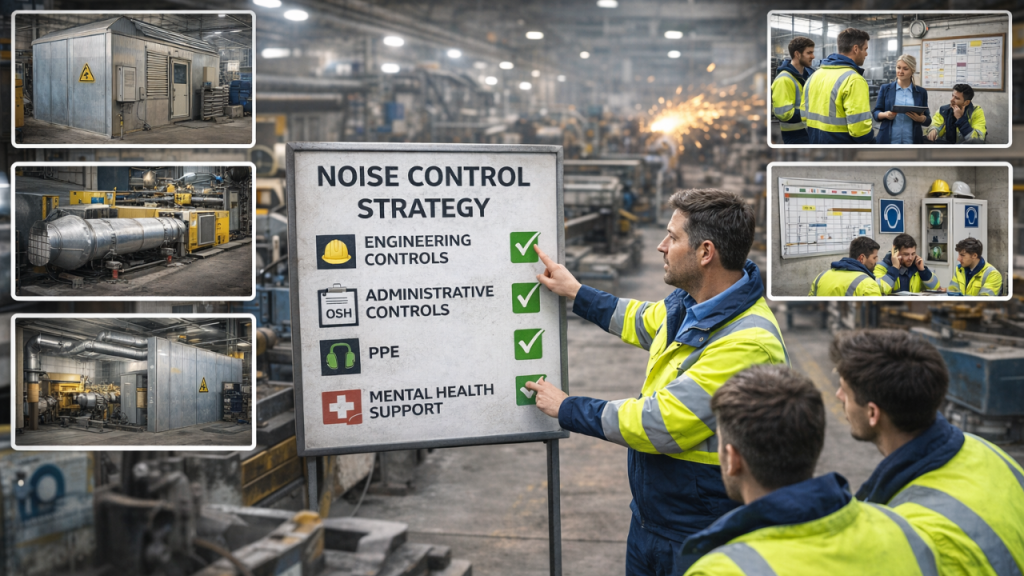
A Practical OSH Playbook: What “Integrated Noise Control” Looks Like
At Kinetics Group, we advocate a layered strategy that addresses both exposure and recovery.
1) Engineering controls (the biggest impact)
Reduce noise at the source and along the transmission path:
- Acoustic enclosures for mechanical equipment and industrial packages
- Acoustic louvers that protect airflow while reducing breakout noise
- Duct silencers / attenuators at fan inlet and discharge paths
- Vibration isolation to cut structure-borne noise and secondary radiation
- Plantroom acoustic treatments to reduce reverberation build-up
2) Administrative controls (reduce dose and strain)
Because the study shows long hours amplify risk, administrative policies matter:
- Task rotation away from highest-noise zones
- Enforced quiet-break opportunities
- Shift planning that avoids prolonged high-noise exposure blocks
- Maintenance scheduling to prevent abnormal noise from worn components
3) PPE (necessary, but not sufficient)
Hearing protection remains essential — but it cannot be the only solution when outcomes include stress and mental wellbeing. PPE is the last line of defence, not the strategy.
4) Stress and mental health support inside OSH
If noise is acting as a psychosocial stressor, OSH programs should respond accordingly:
- Supervisor training to recognise stress escalation
- Simple reporting channels for fatigue and strain
- Periodic wellbeing screening aligned with existing HSE culture
- Practical stress management interventions built into toolbox talks
This is exactly the direction recommended by the study: integrate noise control, working hour regulation, and structured stress management within OSH frameworks.
What This Means for Manufacturing in the GCC and Beyond
Whether it’s a metal fabrication facility, a logistics hub, a food processing plant, or an industrial utility zone, the pattern is the same: high-noise areas often correlate with the highest pressure tasks and longest exposure windows.
Reducing noise exposure isn’t only about protecting ears — it’s about protecting the workforce’s ability to perform safely, consistently, and sustainably.
From Evidence to Implementation: How Kinetics Group Can Support
If your facility is experiencing persistent high-noise zones, or if you’re targeting better worker wellbeing without compromising output, Kinetics Group can support with:
- Site noise risk review (equipment, pathways, reverberation)
- Engineered noise control solutions (enclosures, louvers, silencers, acoustic treatments)
- Practical mitigation strategies that align with operations, maintenance, and OSH priorities
For technical support and engineered industrial noise control solutions:
Email: info@kineticsgroup.ae | sales@kineticsgroup.ae
Telephone: +971 4 885 7361
Website: www.kineticsgroup.ae
Because safer factories aren’t just quieter — they’re healthier.
Reference
Firmansyah, M.R., Harahap, N.I., Dewi, D.C. and Delina, S. (2025) ‘The Impact of Industrial Noise Exposure on Work Stress and Mental Health of Workers: A Study in the Manufacturing Industry’, Sustainable Applied Modification Evidence Community, 2(2), pp. 61–69. doi: 10.69855/samec.v2i2.284. Available at: https://gpijournal.com/index.php/samec/article/view/284 (Accessed: 23 January 2026).