


At Kinetics Group of Companies, we recognise that buildings are not merely physical structures; they are experiential environments that shape how people feel, think, behave, and age. The interaction of sound and light within indoor spaces plays a profound role in shaping emotional stability, cognitive clarity, and psychological resilience — especially among older adults.
A comprehensive 2025 systematic review published in Humanities and Social Sciences Communications by Mu, Li, Qin, Feng & Zhang reinforces what we have long emphasised in our engineering philosophy — that acoustic and visual design are fundamental determinants of human comfort, dignity and mental well-being.
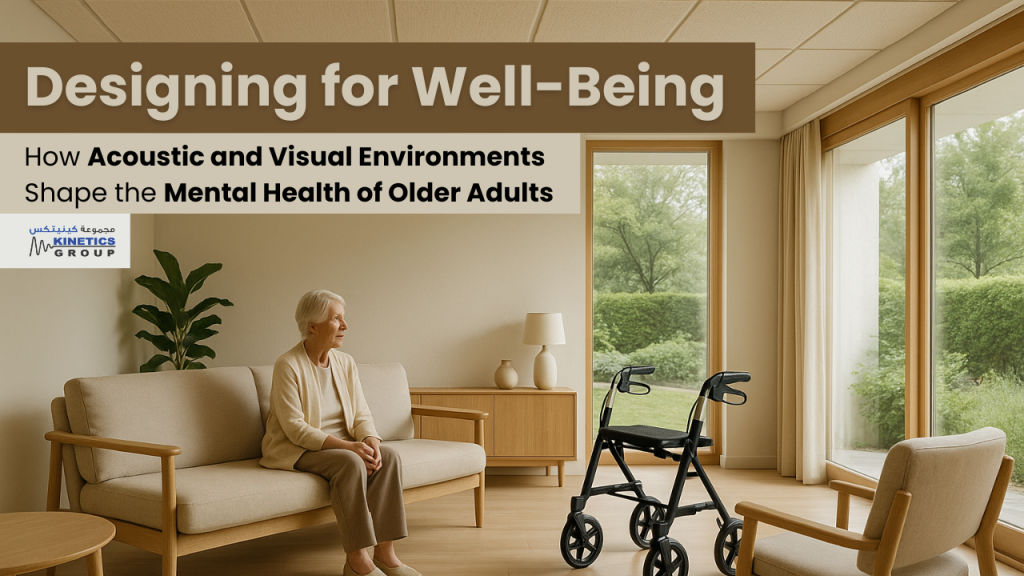
🎧 How Sound Influences the Aging Mind
Noise is far more than a background disturbance; the research identifies it as a persistent environmental stressor. According to Mu et al., poor acoustic environments, including mechanical noise, television noise, and reverberant interiors, are consistently associated with higher levels of anxiety, irritability, and depressive symptoms in older adults (Mu et al., 2025).
This reinforces a critical insight: as adults age, their tolerance to noise reduces significantly, while their emotional sensitivity to sound increases. The study also highlights that older adults with higher levels of loneliness and depression rated their acoustic environment more poorly, suggesting a bi-directional relationship between sound quality and emotional health (Mu et al., 2025).
At the same time, positive acoustic experiences can act as emotional stabilisers. Mu et al. found that daylight and music have a positive effect on the emotional regulation of older adults, particularly in reducing anxiety and depressive symptoms (Mu et al., 2025). Soft music, reduced background noise, and natural soundscapes all demonstrate measurable improvements in mood, cognition, and social engagement.
At Kinetics, these findings align perfectly with our practice:
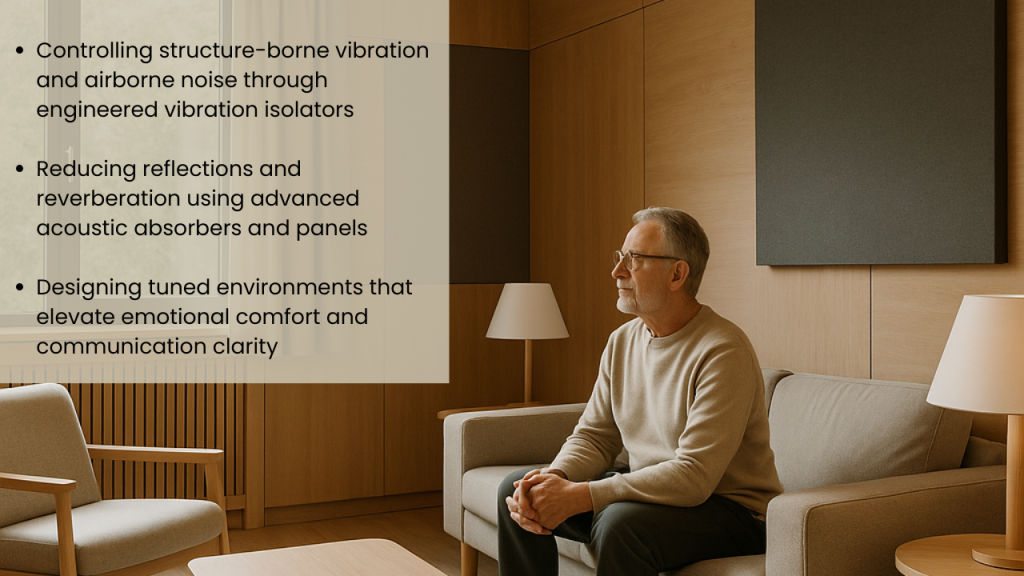
- Controlling structure-borne vibration and airborne noise through engineered vibration isolators
- Reducing reflections and reverberation using advanced acoustic absorbers and panels
- Designing tuned environments that elevate emotional comfort and communication clarity
Our goal is simple: to engineer environments that actively protect psychological well-being.
💡 The Power of Light and Visual Design
Lighting is an emotional language. The 2025 review emphasises that daylight exposure and balanced indoor lighting are strongly associated with reductions in depressive symptoms and improvements in emotional stability in older adults (Mu et al., 2025).
Poor lighting, on the other hand — dimness, glare, visual clutter — can trigger disorientation, reduce spatial confidence and increase emotional stress. Vision naturally declines with age, making lighting quality not just a comfort factor but a mental health determinant.
Crucially, the study found that environmental factors such as noise, lighting, and music significantly influence the emotional and depressive states of older adults (Mu et al., 2025), underscoring that visual and acoustic comfort cannot be separated in practice.
At Kinetics, this evidence is deeply embedded in our design ethos. Our acoustic systems operate in harmony with visual comfort strategies — ensuring that materials, colours, luminance, and spatial textures enhance not only functionality but emotional stability.
🧠 Why Multisensory Environments Matter
A central contribution of the systematic review is the recognition that sound and light interact as a multisensory ecosystem. Mu et al. note that changes in the visual environment may influence auditory perception and its interpretation, thereby affecting emotional responses (Mu et al., 2025).
This means that poor lighting can make noise feel harsher, while pleasant visual conditions can soften acoustic perception — a phenomenon especially pronounced in older adults whose sensory integration capabilities may decline.
For Kinetics, this insight is powerful: creating restorative environments requires synchronising acoustics, lighting, vibration control, and spatial design, not treating them as isolated factors. Our integrated engineering approach — from architectural acoustics to vibration isolation and aesthetic coordination — supports cognitive clarity, emotional balance, and long-term mental well-being.
🏗️ From Research to Real-World Design
The 2025 review provides clear guidance for translating evidence into practice. It highlights several design imperatives:
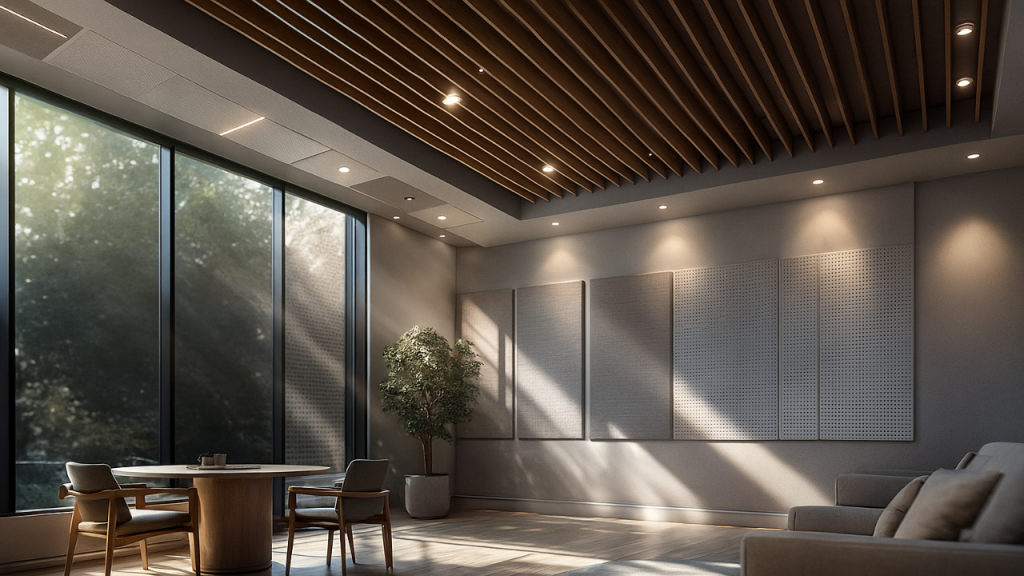
- Quiet HVAC and building systems, achieved through vibration isolators, silencers, flexible connectors
- Balanced visual environments, prioritising daylight access and glare-free material selections
- Accessible, clutter-free layouts, critical for emotional security and safe mobility
Across healthcare, hospitality, education, and residential projects, Kinetics Group applies these same principles — crafting environments that nurture mental health while meeting the most stringent engineering and performance standards.
🌍 Building for Well-Being — the Kinetics Way
Scientific evidence confirms what our work has embodied for decades: good acoustics and lighting are fundamental to mental health. As global populations age, our responsibility as designers and engineers becomes even clearer.
At Kinetics Group, we continue to partner with consultants, architects, and owners to shape buildings that elevate peace, dignity, connection, and emotional well-being — for every stage of life.
📌 Contact Us
For acoustic design support and engineering solutions:
📧 info@kineticsgroup.ae | sales@kineticsgroup.ae
📞 +971 4 885 7361
🌍 www.kineticsgroup.ae
Reference
Mu, J., Li, P., Qin, Z., Feng, Y. and Zhang, C. (2025) The effects of indoor acoustic and visual environments on the mental health of older adults: A systematic review. Humanities and Social Sciences Communications, 12, p.1716. Available at: https://doi.org/10.1057/s41599-025-05981-8