Introduction: Why learning-space acoustics now demand a more sophisticated design conversation
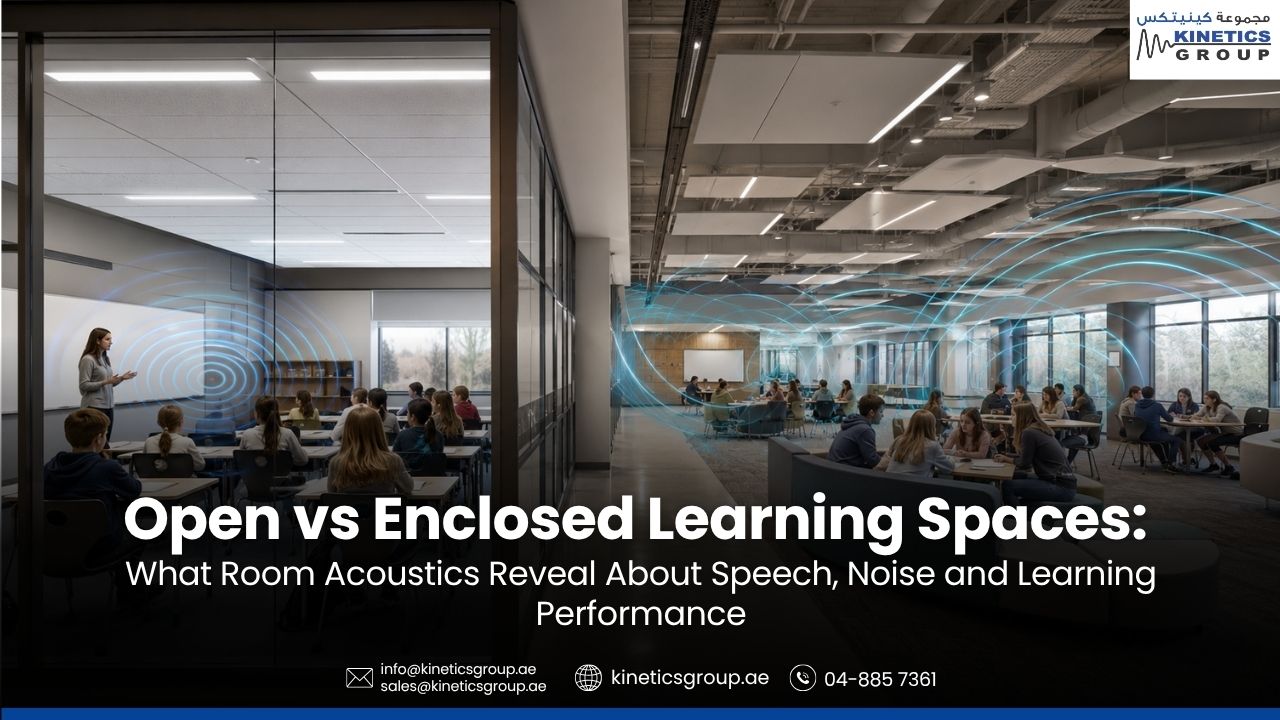
The modern school is no longer defined by the conventional classroom alone. Across many education systems, enclosed learning spaces are being supplemented, and sometimes replaced, by open and flexible learning environments designed to support collaboration, movement, group-based learning and improved space utilisation.
The architectural intent is understandable. Open learning spaces can allow several groups to operate in the same area, support flexible teaching modes and give educators more freedom in how they arrange learning activities. Yet acoustically, these spaces introduce a fundamental engineering challenge: the same openness that improves spatial flexibility can also allow speech, activity noise and distraction to travel further than intended.
A recent measurement study by Keränen, Hongisto and Radun investigated this issue in detail by comparing the room acoustic performance of 73 learning spaces across 20 Finnish schools, including 62 enclosed learning spaces and 11 open learning spaces (Keränen, Hongisto and Radun, 2026). The study measured three critical acoustic indicators: Speech Transmission Index, background noise level and reverberation time. It also examined how speech intelligibility decays with distance, a particularly important factor in open learning environments.
The findings are highly relevant for architects, acoustic consultants, MEP engineers, school operators and facility owners. They show that the acoustic difference between enclosed and open learning spaces is not always obvious when judged by average values alone. The real challenge lies in spatial acoustic behaviour: how far speech travels, how much it distracts other groups and whether acoustic privacy can be achieved without compromising communication within the learning group.
For Kinetics Group, this research reinforces a principle that applies across educational, commercial and critical built environments: acoustic performance is not simply a matter of adding absorption. It is the outcome of coordinated engineering across room geometry, HVAC noise control, reverberation management, speech privacy, zoning, material selection and operational use.
From classroom silence to acoustic functionality
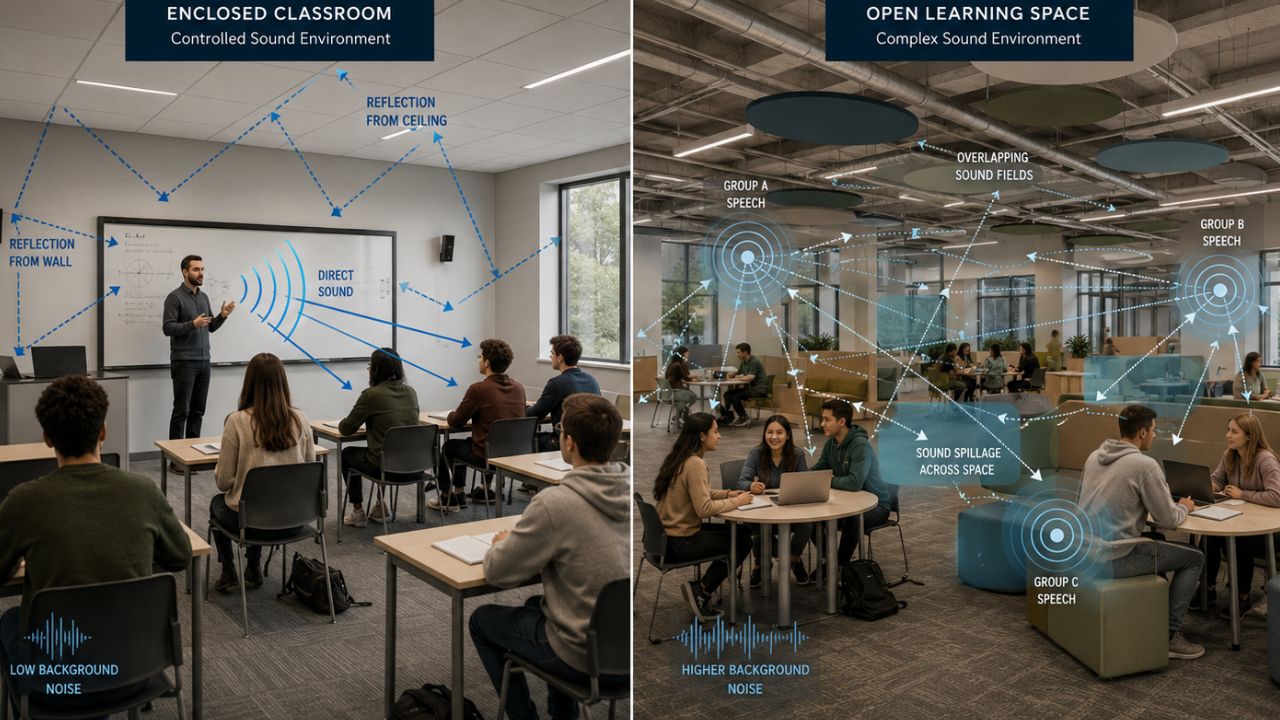
Good educational acoustics is not about creating silent buildings. Schools are active environments. Students discuss, teachers explain, furniture moves and HVAC systems operate continuously in the background. The acoustic objective is therefore functional: speech should be clear where it is needed and sufficiently controlled where it becomes a distraction.
In enclosed learning spaces, this requirement is relatively direct. A teacher’s speech must remain intelligible across the room, background noise must remain low enough to support listening, and reverberation must be controlled to avoid smearing speech. In open learning spaces, the challenge becomes more complex. Speech must be intelligible within one learning group but should decay quickly enough that it does not interfere with adjacent groups.
Keränen, Hongisto and Radun found that enclosed learning spaces achieved Speech Transmission Index values between 0.64 and 0.83, while open learning spaces ranged from 0.47 to 0.91 (Keränen, Hongisto and Radun, 2026). At first glance, this suggests that open learning spaces can perform very well in some positions. However, the wider range also reveals the central problem: acoustic quality in open learning environments can vary significantly depending on distance, layout and the presence or absence of sound-blocking elements.
This is why relying only on room-average acoustic values can be misleading. In open spaces, the question is not simply whether speech is intelligible. The more important question is where speech remains intelligible, and whether it remains too intelligible at distances where privacy and concentration are required.
Speech Transmission Index: when clarity becomes a distraction
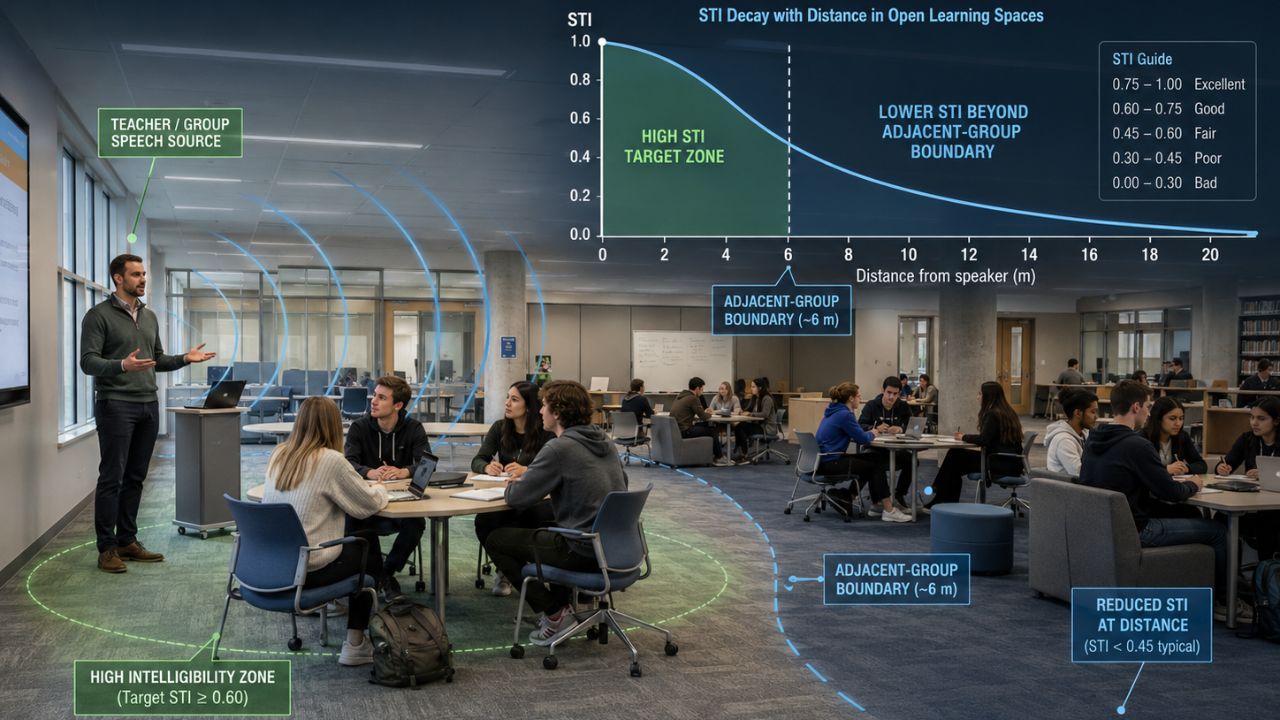
Speech Transmission Index, or STI, is a key measure of how clearly speech can be understood. In a conventional classroom, a high STI is generally beneficial because the teacher’s voice must reach students across the space. However, in an open learning environment, high STI at long distances can become problematic because speech from one group can remain understandable to another group.
The study found that the mean maximum STI in enclosed learning spaces was 0.77, while the mean minimum STI was 0.72. In open learning spaces, the mean maximum STI was higher at 0.82, but the mean minimum STI dropped to 0.65 (Keränen, Hongisto and Radun, 2026). This demonstrates a wider spatial variation in open environments.
The Finnish target values referenced in the study require open learning spaces to achieve high speech intelligibility within the learning group, but lower intelligibility between physically separated groups at longer distances (Keränen, Hongisto and Radun, 2026). This is a crucial distinction. In acoustic engineering terms, an open learning space must simultaneously support communication and privacy. These are competing requirements unless the space is carefully designed.
The study found that only 9% of open learning spaces fulfilled the overall Finnish target values, compared with 56% of enclosed learning spaces (Keränen, Hongisto and Radun, 2026). The main reason for non-compliance in open learning spaces was that STI remained too high at longer distances. In practical terms, speech from one group remained too understandable to other groups.
For real projects, this finding has major implications. A visually open space may appear flexible and modern, but without acoustic zoning, absorptive treatment, barriers, controlled background sound and careful HVAC noise management, it can become an environment where multiple speech streams compete for attention.
Reverberation time: why absorption alone is not enough
Reverberation time remains one of the most familiar acoustic parameters in building design. It describes how long sound persists in a space after the source stops. Excessive reverberation can reduce speech clarity, increase vocal effort and raise overall noise levels. In classrooms, lower reverberation generally improves listening conditions, especially for younger students or those with hearing, language or attention challenges.
In the study, reverberation time in enclosed learning spaces ranged from 0.34 to 0.82 seconds. In open learning spaces, it ranged from 0.44 to 0.72 seconds (Keränen, Hongisto and Radun, 2026). The differences between enclosed and open learning spaces were smaller than might be expected, which suggests that many open spaces had some level of absorptive treatment.
However, reverberation control alone did not solve the open-space problem. While absorption can reduce reflected sound energy, it does not necessarily block horizontal speech transmission between groups. The authors concluded that open learning spaces may require not only larger sound absorption areas but also dividing elements, such as sound-absorbing screens, to limit speech propagation between groups (Keränen, Hongisto and Radun, 2026).
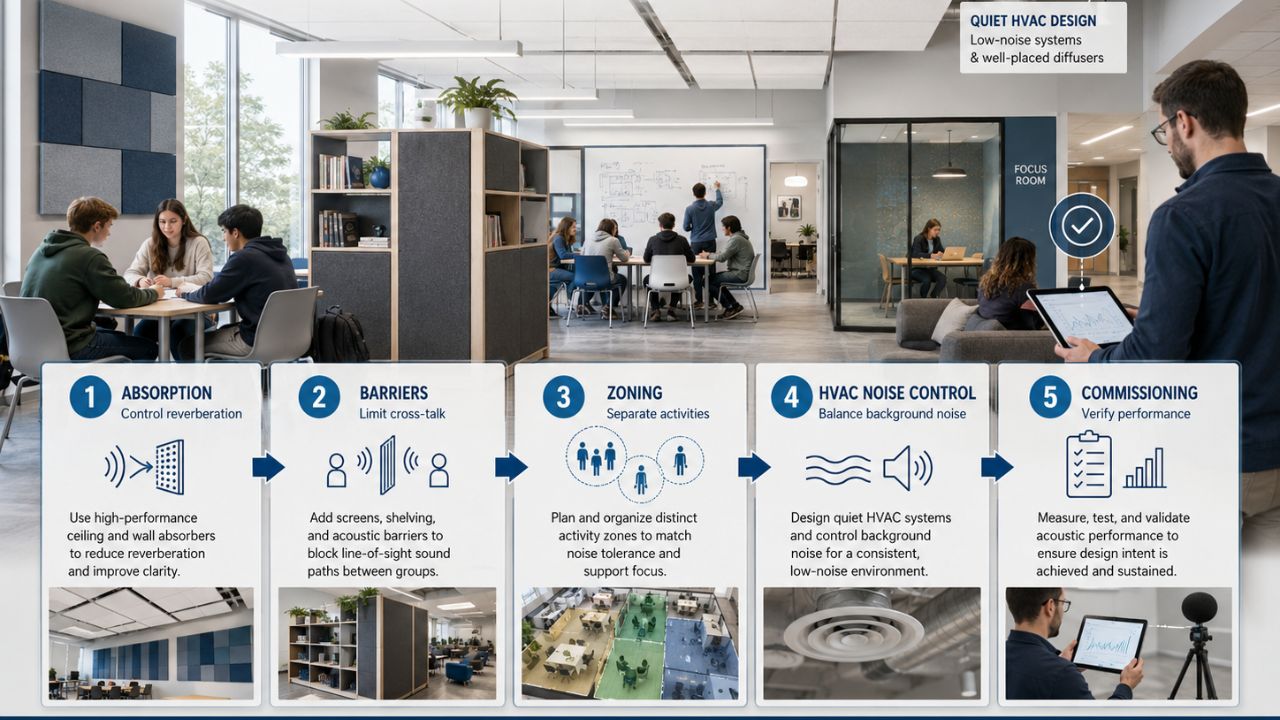
This distinction is critical for engineering practice. Ceiling absorption can improve overall acoustic comfort, but it cannot fully replace spatial separation. In open learning spaces, effective acoustic design requires a layered strategy: absorptive ceilings, absorptive wall surfaces, acoustic furniture, barriers, zoning and background sound control.
For Kinetics Group’s project experience across acoustic engineering and building performance, this aligns closely with broader lessons from open-plan offices, healthcare facilities and multi-use public environments. Sound must be managed not only vertically through absorption, but horizontally through transmission-path control.
Background noise: the HVAC connection
Background noise in the study was primarily associated with building services, particularly mechanical ventilation operating in normal daytime mode. The researchers measured A-weighted background noise levels from 25 to 47 dB in enclosed learning spaces and from 29 to 44 dB in open learning spaces (Keränen, Hongisto and Radun, 2026).
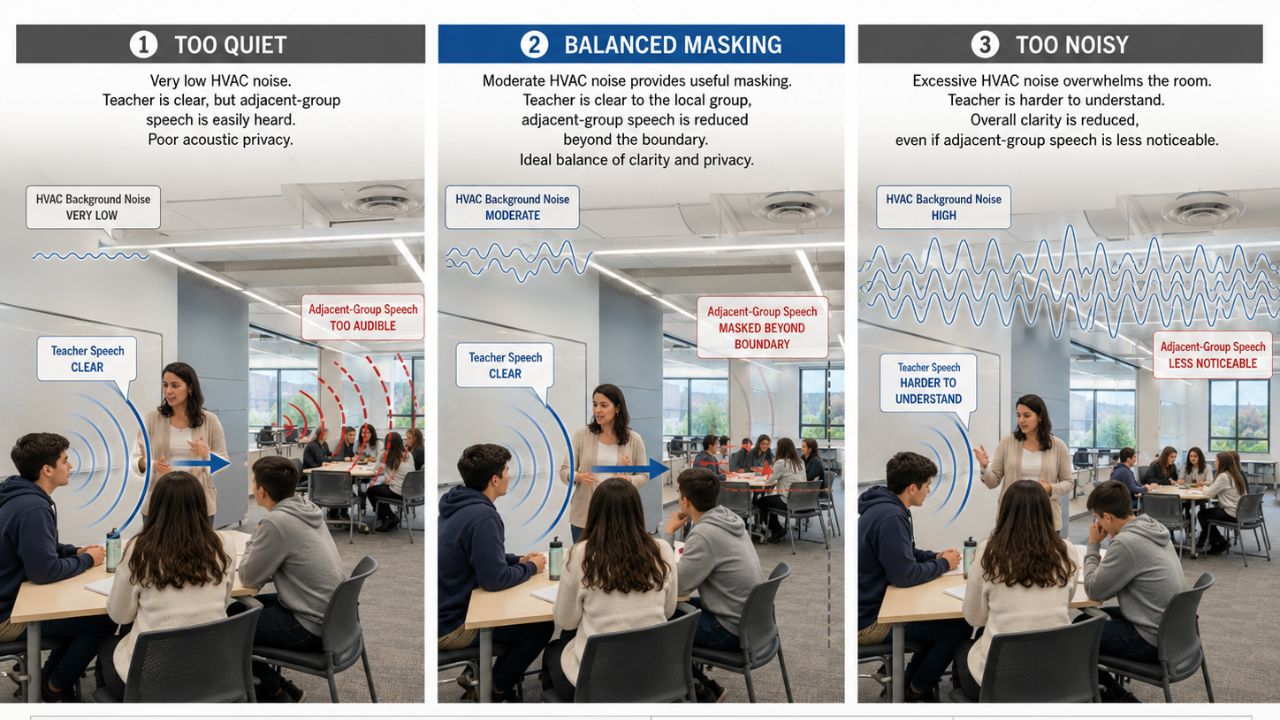
These values show that HVAC noise can vary significantly between spaces, even within similar building types. This variation matters because background noise has a direct influence on speech intelligibility. If background noise is too high, speech becomes harder to understand. If it is too low in an open learning space, distant speech may remain too intelligible, increasing distraction between groups.
This creates a subtle but important design issue. In enclosed classrooms, low HVAC noise is usually desirable. In open learning spaces, however, the acoustic design sometimes requires a controlled masking sound environment to reduce speech intelligibility at longer distances. The study notes that Finnish guidance recommends artificial sound masking in open learning spaces to help achieve lower STI beyond group boundaries (Keränen, Hongisto and Radun, 2026).
This does not mean that noisy ventilation should be tolerated. Poor HVAC noise is rarely an acceptable masking strategy because it is uncontrolled, spectrally uneven and often associated with annoyance. Instead, the objective should be engineered background sound: stable, balanced and coordinated with the room acoustic design.
For MEP and acoustic consultants, the lesson is clear. HVAC systems in schools should not be designed for airflow and thermal comfort alone. Ductborne noise, diffuser noise, breakout noise, plantroom transmission, vibration isolation and commissioning measurements all influence the final learning environment.
Spatial decay: the missing metric in many learning-space designs
One of the most important contributions of the study is its use of spatial decay measurement methods based on ISO 3382-3, a standard commonly associated with open-plan offices. Rather than measuring only average acoustic conditions, the researchers measured how STI and speech sound pressure level changed with distance from the speaker (Keränen, Hongisto and Radun, 2026).
This approach is especially valuable for open learning spaces because it reflects real operational behaviour. A student does not experience an average room. A student experiences the sound arriving at their location from teachers, classmates, neighbouring groups and building services.
The study found that the spatial decay rate of speech was higher in open learning spaces than in enclosed learning spaces. Enclosed learning spaces had a mean spatial decay rate of 2.4 dB, while open learning spaces had a mean of 4.2 dB (Keränen, Hongisto and Radun, 2026). This suggests that speech level reduced more quickly with distance in open spaces. However, the reduction was still often insufficient to achieve the required speech privacy between groups.
This finding is highly relevant for acoustic design. It shows that open learning spaces may require performance criteria similar to those used in open-plan workplaces, where distraction distance and speech privacy are central design concerns. It also suggests that educational acoustic design should move beyond single-point or room-average measurements.
A well-designed open learning environment should be tested across actual teaching positions, group boundaries and student zones. Acoustic commissioning should ask not only “is the reverberation time acceptable?” but also “how far does intelligible speech travel?”
What the research means for real school projects
The study’s findings translate into several practical engineering lessons.
First, enclosed classrooms remain acoustically easier to control. Their geometry naturally limits sound propagation, and the main design requirements are clear: manage reverberation, control background noise and ensure speech intelligibility across the teaching area.
Second, open learning spaces require a higher level of acoustic coordination. They cannot be treated as larger classrooms. Their acoustic behaviour is closer to open-plan offices, where speech privacy, distraction control and spatial decay become major performance criteria.
Third, absorption must be strategically placed. Ceiling absorption is important, but wall absorption, absorptive furniture and acoustic barriers can be equally important when controlling horizontal sound propagation.
Fourth, HVAC noise must be engineered rather than accepted. Ventilation systems should support low-noise operation, but in open learning environments, they may need to be considered alongside controlled sound masking and acoustic privacy requirements.
Finally, acoustic performance should be verified through measurement. The study revealed large variation across spaces, which confirms that design intent alone is not enough (Keränen, Hongisto and Radun, 2026). Commissioning should include background noise, reverberation and speech intelligibility measurements at representative locations.
Sustainability and operational performance: acoustics as part of building quality
Acoustic comfort is often discussed as a human-experience issue, but it is also a sustainability issue. A building that supports concentration, communication and wellbeing is more likely to remain functional over its lifecycle. Conversely, a space that requires operational workarounds, behavioural restrictions or post-occupancy retrofits is less efficient from both environmental and economic perspectives.
The study highlights that open learning spaces are often adopted partly for space utilisation benefits (Keränen, Hongisto and Radun, 2026). However, efficient floor-area use must be balanced against acoustic functionality. A space that accommodates more students on paper may underperform if acoustic distraction reduces teaching effectiveness, concentration or staff satisfaction.
From a building-performance perspective, acoustic design should therefore be integrated early with architectural planning, HVAC design and sustainability objectives. Retrofitting acoustic control after occupation is typically more disruptive and less efficient than designing it correctly from the beginning.
This is particularly important in schools, where the consequences of poor acoustic design are experienced daily by teachers and students. Better acoustic environments can reduce vocal strain, improve listening conditions and support more inclusive learning. While the study does not establish a direct causal link between measured room acoustics and teacher satisfaction, it provides suggestive evidence that room acoustic conditions may help explain why teachers in open learning spaces report lower acoustic satisfaction (Keränen, Hongisto and Radun, 2026).
Practical recommendations for consultants, designers and facility owners
For enclosed learning spaces, acoustic design should focus on achieving appropriate reverberation control, low HVAC noise and consistent speech intelligibility throughout the student area. These spaces can generally meet acoustic targets using established classroom design methods when acoustic and MEP coordination is properly implemented.
For open learning spaces, design teams should adopt a more advanced acoustic strategy. The layout should define clear learning zones, expected teaching positions and separation requirements between groups. Acoustic modelling should evaluate speech propagation paths, not only reverberation time. Sound-absorbing ceilings should be combined with vertical acoustic elements such as screens, absorptive partitions, storage walls or acoustic furniture.
Where appropriate, controlled sound masking should be considered as part of the acoustic system. However, masking must be designed carefully and should not be confused with uncontrolled HVAC noise. The goal is not simply to increase background sound, but to create a balanced acoustic environment where nearby speech remains clear and distant speech becomes less distracting.
Commissioning should include field measurements of background noise, reverberation time, STI and spatial decay. These measurements should be carried out at realistic source and receiver positions that reflect actual teaching and learning activities.
Most importantly, acoustic design should be treated as a performance discipline, not a finishing item. By the time ceilings, partitions and HVAC systems are installed, many acoustic outcomes are already locked in. Early-stage engineering input is essential.
From Evidence to Engineering Practice
The research by Keränen, Hongisto and Radun provides a valuable evidence base for a discussion that is becoming increasingly important in modern school design. Open and flexible learning spaces can offer educational and operational benefits, but they demand a more sophisticated acoustic strategy than conventional classrooms.
The study shows that more than half of enclosed learning spaces met the Finnish acoustic target values, while only a small proportion of open learning spaces did so (Keränen, Hongisto and Radun, 2026). The most significant issue was not simply excessive reverberation or high background noise. It was the persistence of intelligible speech at longer distances, where one group’s communication becomes another group’s distraction.
This is precisely where engineering-led design becomes essential. Effective acoustic performance depends on the integration of research, simulation, product selection, manufacturing quality, site installation and post-occupancy verification. It requires acoustic consultants, architects, HVAC engineers, contractors and facility owners to work from a shared performance objective.
At Kinetics Group, this is the bridge we help create: from research to design, from design to engineered solutions, from engineered solutions to site implementation, and from site implementation to measurable operational performance.
For educational buildings, acoustic excellence is not an optional enhancement. It is part of indoor environmental quality, sustainability, teaching effectiveness and long-term building value.
To discuss acoustic engineering, HVAC noise control, vibration isolation, room acoustic treatment or performance-led building solutions for your next project, contact Kinetics Group.
Email: info@kineticsgroup.ae | sales@kineticsgroup.ae
Telephone: +971 4 885 7361
Website: www.kineticsgroup.ae
Because true acoustic excellence is not about making schools quieter. It is about making learning clearer.
References
Keränen, J., Hongisto, V. and Radun, J. (2026) ‘Room Acoustic Differences Between Enclosed and Open Learning Spaces’, Acoustics, 8(1), 17.