A research-led interpretation of how high-static-low-dynamic-stiffness systems, adaptive mechanisms and multidirectional isolation can reshape vibration control for precision equipment, transport, infrastructure and building services.
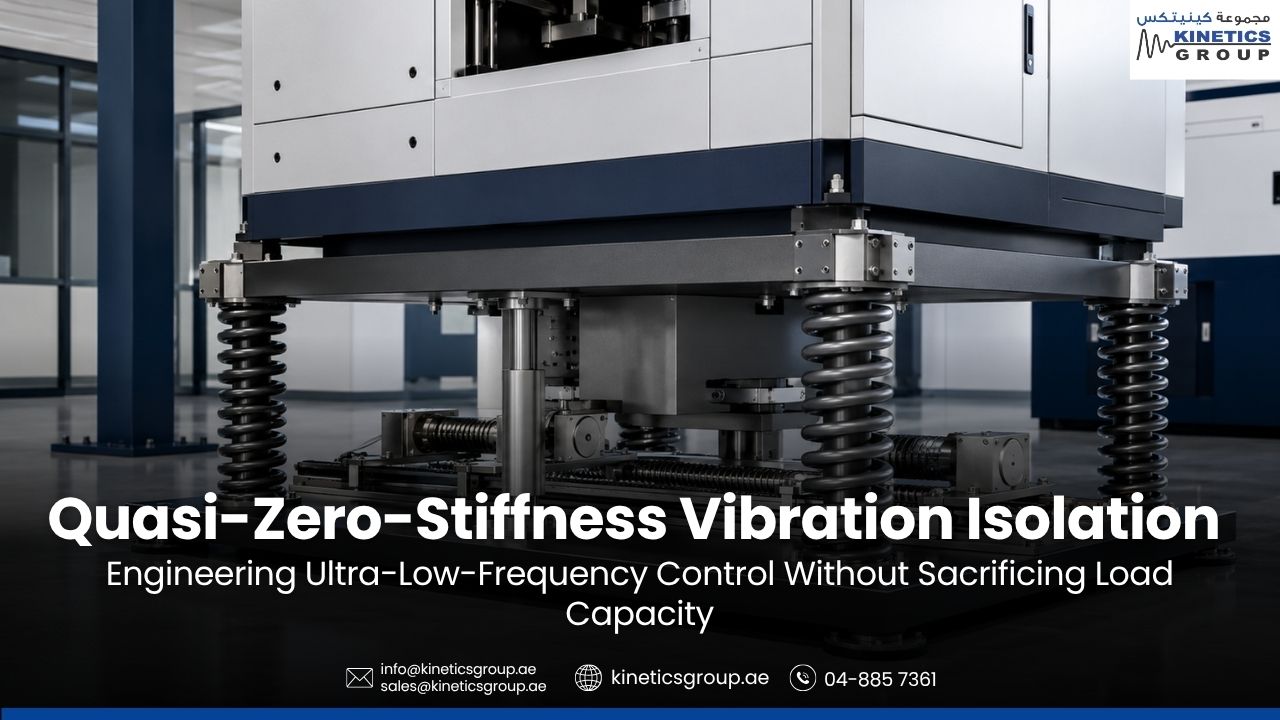
Designing an isolator that is soft dynamically but strong statically
Low-frequency vibration isolation is governed by an uncomfortable compromise. A conventional passive isolator must be soft enough to move its natural frequency below the disturbing frequency, yet stiff enough to support the equipment without excessive static deflection. For heavy plant, precision machinery and equipment with variable operating loads, those two requirements can pull the design in opposite directions.
The review by Jiao, Xu and Wang examines quasi-zero-stiffness (QZS) vibration isolation as a way to break that compromise. QZS systems combine positive and negative stiffness so that the supported mass can retain high static load capacity while the incremental stiffness around the operating equilibrium becomes very small. This high-static-low-dynamic-stiffness (HSLDS) behaviour extends useful isolation towards lower frequencies without requiring the entire support system to become statically soft (Jiao et al., 2026).
The engineering lesson is more important than any one mechanism. Multi-spring, linkage, cam-roller, magnetic, biomimetic, origami and metamaterial concepts all seek the same result: control the force-displacement slope where the system actually operates. The review also makes clear that QZS is not automatically benign. Load drift, friction, nonlinear damping, sub-harmonic and super-harmonic resonance, bifurcation and chaos can all erode the theoretical advantage if the isolator is not tuned and validated as a system (Jiao et al., 2026).
| ENGINEERING ANSWER IN ONE PARAGRAPH Quasi-zero-stiffness isolation does not remove stiffness from a support; it redistributes stiffness. Positive stiffness carries the static load, while a negative-stiffness mechanism offsets the dynamic slope near equilibrium. The resulting low dynamic stiffness can push isolation to much lower frequencies than a comparable linear mount. The practical challenge is maintaining that operating point as load, amplitude and excitation direction change, while controlling nonlinear resonance, travel, damping and stability (Jiao et al., 2026). |
Research results at a glance
| Adaptive / tuned systems | Multidirectional isolation | Application evidence |
| A mechanically load-adaptive QZS design reviewed by the authors widened isolation bandwidth by 23%. A separate adaptive cam-roller system switched modes in 430 ms and reduced the resonance peak by 87.5% (Jiao et al., 2026). | One experimentally validated passive 6-DOF QZS platform achieved natural frequencies of 1.3–1.9 Hz in all directions, with transmissibility below unity from approximately 2.1–3.1 Hz depending on direction (Jiao et al., 2026). | Seat-isolation studies reported a 67.2% reduction in RMS displacement under 0.1–10 Hz random excitation and an 87.65% reduction in RMS acceleration for a heavy-duty-truck seat concept under realistic road excitation (Jiao et al., 2026). |
The reported percentages describe different systems, tests and performance metrics and should not be compared as if they were a single benchmark.
1. Why low-frequency vibration isolation is a stiffness problem
For a linear spring-mass system, lowering the natural frequency usually means lowering stiffness. That helps dynamic isolation but increases static deflection and can compromise alignment, clearances, travel and load-bearing capacity. Jiao et al. identify this load-capacity-versus-isolation-frequency trade-off as the central limitation that motivated QZS development (Jiao et al., 2026).
QZS changes the design target from “make the spring softer” to “make the tangent stiffness near the operating point smaller.” A vertical spring, air spring, elastic beam or magnetic element can still carry the static mass, while a second mechanism contributes negative stiffness over a selected displacement range. When the positive and negative stiffness contributions nearly cancel at equilibrium, the local dynamic stiffness approaches zero while the static support force remains finite (Jiao et al., 2026).
For consultants, this distinction matters because static deflection alone no longer tells the whole story. A QZS support must be assessed through its complete force-displacement curve, load envelope and dynamic response. The relevant questions become: Where is the equilibrium? How wide is the useful low-stiffness plateau? How does that plateau move with load? What happens when the excitation amplitude pushes the system beyond it?
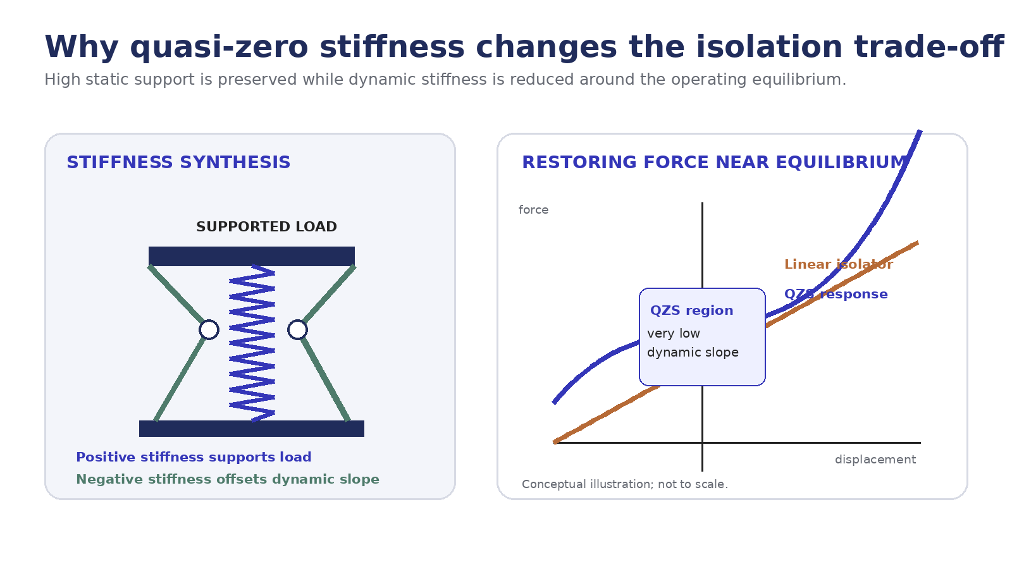
Figure 1. Why QZS changes the isolation trade-off. The schematic shows positive and negative stiffness working together so that the supported load remains statically stable while the restoring-force curve has a very small slope around equilibrium. Original explanatory graphic derived from Jiao et al. (2026).
2. One principle, seven mechanical routes
The review classifies single-degree-of-freedom QZS isolators into seven principal design archetypes: multi-spring, spring-linkage, cam-roller, magnetic, biomimetic, origami-inspired and metamaterial-based structures. The diversity is significant because it shows that QZS is a mechanical design principle rather than a single product architecture (Jiao et al., 2026).
Multi-spring systems are the most recognisable form, typically combining a vertical positive-stiffness spring with inclined or transverse elements that generate negative stiffness through geometry. Spring-linkage systems pursue the same effect using levers, scissor mechanisms or compliant links. Cam-roller designs shift the design freedom into the cam profile, allowing the restoring-force curve to be shaped more directly. Magnetic systems generate negative stiffness without contact and can offer useful adjustability through magnet spacing or field control (Jiao et al., 2026).
The newer families move further away from assembled springs. Biomimetic concepts borrow load paths from limbs, muscles and skeletal structures; origami systems exploit folding geometry; and metamaterial or meta-structure concepts build the required force-displacement response into repeating or topologically optimised architectures. The review highlights topology optimisation as an increasingly important inverse-design route for monolithic QZS structures with programmable stiffness and multiple low-stiffness plateaus (Jiao et al., 2026).
| PRACTICAL DESIGN IMPLICATION Mechanism selection should follow the project constraint, not the novelty of the mechanism. A cam profile may suit precise stiffness tailoring; a magnetic concept may suit low-friction micro-vibration control; a linkage can offer practical mechanical adjustment; and a monolithic metamaterial may suit additive manufacturing or tight packaging. The correct route depends on load, stroke, friction, maintainability, environment, fail-safe behaviour and manufacturing tolerance. |
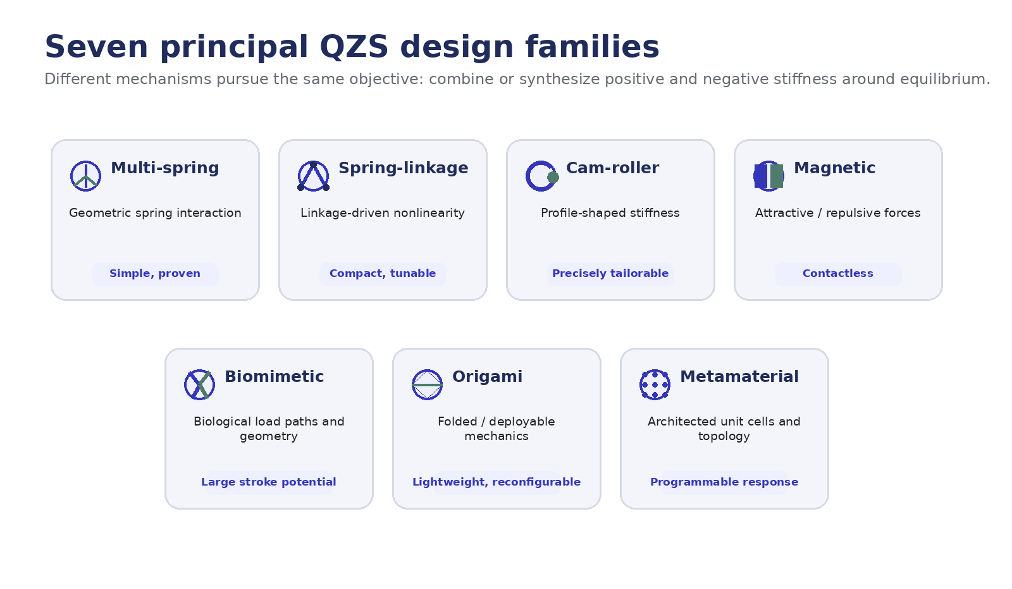
Figure 2. Seven principal QZS design families. The visual groups the main single-degree-of-freedom architectures reviewed by Jiao et al. and highlights how different physical mechanisms can produce the same high-static-low-dynamic-stiffness objective. Original explanatory graphic derived from Jiao et al. (2026).
3. Load adaptability is the difference between a laboratory point and a field operating range
Early QZS concepts were often tuned for one static load. The review identifies this as a practical weakness: when the supported mass changes, the equilibrium position can move away from the designed quasi-zero-stiffness region, degrading isolation or stability. Adjustable and load-adaptive designs have therefore become a major development direction (Jiao et al., 2026).
The reviewed solutions tune the system through mechanical preload, replaceable springs, movable linkages, magnet spacing, cam geometry or pneumatic parameters. One mechanically adjustable multi-spring design widened the isolation bandwidth by 23% by correcting stiffness mismatch under changing loads. Other approaches create multiple equilibrium states, continuously adjustable bearing capacity, or wide quasi-zero-stiffness plateaus so that effective isolation is less sensitive to payload variation (Jiao et al., 2026).
For building-services equipment, this is an especially relevant design question. Pumps, fans, compressors and packaged equipment can experience changing fluid inventory, operating speed, duty stage, accessory load or maintenance configuration. The reviewed paper does not directly validate QZS mounts on commercial HVAC plant, so performance cannot be transferred by assumption. It does, however, establish a clear engineering principle: any low-frequency isolator intended for variable-duty equipment should be checked across the real operating mass and excitation envelope, not only at nominal nameplate load (Jiao et al., 2026).
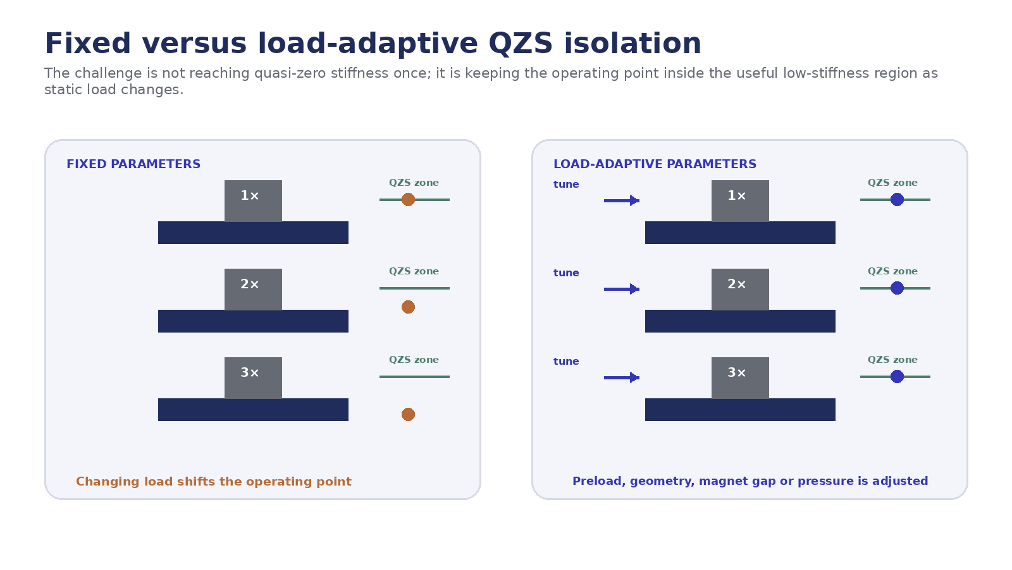
Figure 3. Fixed versus load-adaptive QZS isolation. The diagram illustrates why a fixed QZS operating point can drift as static load changes, while adaptive tuning seeks to keep the equilibrium inside the useful low-dynamic-stiffness region. Original explanatory graphic derived from Jiao et al. (2026).
4. The nonlinear advantage is also the nonlinear risk
QZS isolators are inherently nonlinear. The same shaped force-displacement relationship that produces very low dynamic stiffness can also create response features that do not appear in an ideal linear mount. The review discusses sub-harmonic and super-harmonic resonance, jump phenomena, coexisting periodic solutions, bifurcations and chaotic motion across several QZS architectures (Jiao et al., 2026).
This is not a reason to avoid QZS; it is a reason to engineer it properly. The review reports, for example, that delayed feedback can enlarge stable operating regions when tuned appropriately, while the wrong feedback sign can cause isolation failure. In magnetic systems, electromagnetic shunt damping has been used to suppress nonlinear jumps, with one reviewed study reporting a 40% reduction in the resonance peak. An adaptive cam-roller system that switched between QZS and linear modes according to identified excitation frequency achieved a 430 ms switching time and an 87.5% reduction in the resonance peak (Jiao et al., 2026).
| WHAT SPECIFIERS SHOULD NOT OVERLOOK A low calculated natural frequency is not sufficient evidence of robust isolation. The design should be checked for amplitude dependence, jump-up and jump-down frequencies, sub-harmonic response, nonlinear damping, travel limits, friction, preload tolerance and sensitivity to mass variation. For critical equipment, forward and reverse frequency sweeps and broadband/random testing are often more informative than a single harmonic response curve. |
5. From SDOF mounts to multidirectional isolation platforms
As precision equipment and complex structures become more sensitive to coupled disturbance, a single vertical degree of freedom is often inadequate. The review therefore traces QZS development into 2-DOF, 3-DOF and 6-DOF systems that coordinate low dynamic stiffness across translational and rotational directions (Jiao et al., 2026).
The reviewed 2-DOF concepts address combinations such as two in-plane translations or coupled translation and rotation. Three-degree-of-freedom systems extend the principle to three translations or to two translations plus rotation. Six-degree-of-freedom platforms use leaf springs, Stewart-platform arrangements, magnetic suspension, X-shaped mechanisms or buckling struts to create low-frequency isolation while managing cross-axis coupling (Jiao et al., 2026).
One passive 6-DOF concept using oblique and vertical springs together with Euler buckling struts achieved natural frequencies between 1.3 and 1.9 Hz in all directions; transmissibility fell below unity within approximately 2.1–3.1 Hz, depending on direction, and testing under varying loads agreed closely with simulation (Jiao et al., 2026). The result is useful not as a universal performance target, but as evidence that multidirectional QZS behaviour can be realised and experimentally correlated.
In practical plant rooms and precision facilities, this supports a broader design view: vertical isolation, rocking, torsion, pipe or duct reactions, flexible connections and seismic restraints should be considered as one coupled load-path problem. A mount that performs well vertically can still transmit energy through rigid services or allow unacceptable rotational motion if the complete system is not coordinated.
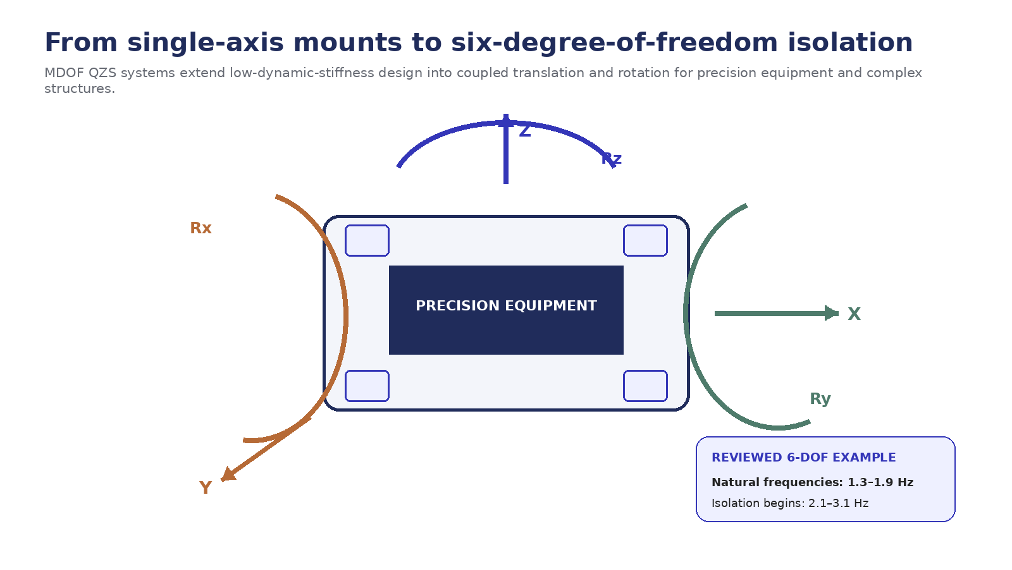
Figure 4. From SDOF to six-degree-of-freedom QZS isolation. The visual shows translational and rotational directions acting on a supported equipment platform and annotates one experimentally validated passive 6-DOF example reported in the review. Original explanatory graphic derived from Jiao et al. (2026).
6. What the engineering applications demonstrate
The review deliberately spans applications rather than ranking one QZS architecture against another. Its examples include vehicle seats, aerospace systems, vibration energy harvesting, bridge seismic protection, precision manufacturing, medical transport and underwater equipment (Jiao et al., 2026). This breadth is important because it reveals what QZS is already being asked to solve: low-frequency excitation, tight packaging, sensitive payloads, variable loads and multidirectional disturbance.
Vehicle and seat isolation
Vehicle-seat studies show the human-performance value of moving isolation into the low-frequency region. One reviewed seat system reduced RMS displacement by 67.2% under 0.1–10 Hz random excitation. A heavy-duty-truck seat isolator achieved an initial isolation frequency as low as 1.1 Hz under harmonic testing and reduced RMS acceleration by 87.65% under realistic random road excitation, with isolation under random excitation beginning at approximately 2 Hz (Jiao et al., 2026).
Precision manufacturing and transport
For ultra-precision machine tools, the review describes a 6-DOF system combining passive air springs with active giant-magnetostrictive actuators. Under active control, vibration displacement was reduced by a factor of four to six compared with the uncontrolled case, including in the ultra-low-frequency range (Jiao et al., 2026). The broader lesson is that QZS and HSLDS concepts can be paired with active control when passive mechanics alone cannot cover the full disturbance band.
Aerospace and high-sensitivity payloads
Aerospace examples include helicopter transmission isolation, adjustable-stiffness joints for spacecraft panels, data-driven control of nonlinear whole-spacecraft isolation and cross-frequency micro-vibration control. The review also describes a compact tunable QZS metamaterial based on truncated conical shells that reduced its initial bandgap frequency by 46.6% to 15.01 Hz through pre-displacement tuning, with theoretical, numerical and experimental validation (Jiao et al., 2026).
Civil, seismic and medical applications
For bridges and protected equipment, the review reports negative-stiffness and QZS concepts that reduce low-frequency seismic response by combining the structure’s positive stiffness with a deliberately engineered negative-stiffness device. Experimental and numerical studies on HSLDS and QZS seismic isolators showed reduced acceleration transmissibility and force amplification, while also highlighting that a perfect QZS equilibrium can be more sensitive to load variation than an HSLDS system with residual stiffness (Jiao et al., 2026).
Medical transport offers another instructive case. A neonatal incubator supported on four spring-magnet QZS isolators achieved effective isolation above 3.2 Hz under operational load, while individual isolators began isolating from 2 Hz. This application illustrates why low-frequency performance, payload sensitivity and fail-safe support must be considered together when the protected occupant or instrument is highly sensitive (Jiao et al., 2026).
7. What QZS could mean for HVAC and building-performance engineering
The paper is not an HVAC field trial, and it does not claim quantified energy, acoustic or service-life benefits for chillers, air-handling units, pumps or cooling towers. Any transfer to building services must therefore be treated as an engineering interpretation rather than a reported application (Jiao et al., 2026).
The relevance is strongest where conventional isolation is constrained by very low forcing frequencies, high static load, limited allowable deflection or a sensitive receiving structure. Examples could include variable-speed rotating equipment near critical spaces, precision laboratories, rooftop plant above lightweight floors, or machinery with slow-speed components that sit close to structural modes. In such cases, HSLDS or QZS concepts may offer another route when simply increasing static deflection is impractical.
The design must still resolve the whole vibration path. Equipment operating speed and harmonics, base stiffness, mount spacing, centre of gravity, connected pipework and ductwork, flexible connector stiffness, housekeeping pads, structural modes and seismic restraints can all influence field performance. In seismic regions, an isolator’s low dynamic stiffness does not remove the need for positive restraint, displacement clearance and code-compliant load transfer; acoustic, vibration and seismic requirements should be coordinated from the beginning.
| HVAC DESIGN QUESTION Is the difficulty truly the mount’s vertical natural frequency, or is the dominant path a rigid pipe, duct, cable tray, restraint, flexible-connector spring rate, slab mode or rotational response? QZS can only add value after the real transmission path and operating spectrum are defined. |
8. Sustainability: precision, durability and avoiding overdesign
The review does not quantify building-energy savings or embodied-carbon reductions from QZS isolation, so sustainability claims should remain evidence-based. Its strongest sustainability relevance lies in design precision: achieving low-frequency isolation without relying solely on very soft, high-deflection supports can reduce the pressure to oversize structural clearances or accept poor dynamic performance. Adjustable and programmable concepts may also allow one platform to accommodate a broader load envelope rather than being retuned or replaced whenever operating mass changes (Jiao et al., 2026).
At the same time, the review identifies durability and cost as unresolved industrialisation challenges. Fatigue, wear, friction, magnetic stability, material ageing, manufacturing tolerance and maintenance complexity can determine whether a sophisticated nonlinear mechanism remains effective over years of service. The authors specifically call for structural simplification, standardisation, modularisation, additive manufacturing, smart materials and improved interdisciplinary collaboration as routes to wider deployment (Jiao et al., 2026).
For whole-life engineering, the sustainability question is therefore not “How close can the stiffness get to zero?” It is “Can the required isolation be delivered reliably, maintainably and safely over the expected service life with the least total material, intervention and operational disruption?”
9. A consultant-grade route from concept to commissioning
The review’s future directions point towards adaptive structures, hybrid active and semi-active control, smart materials, topology optimisation, machine learning, additive manufacturing and digital-twin-based feedback. Those tools can expand what QZS systems can do, but the project workflow still begins with conventional engineering discipline: define the disturbance, define the load, model the nonlinear response, test the hardware and verify the installed interfaces (Jiao et al., 2026).
1. Define the vibration duty
Establish the forcing spectrum, operating speeds, transients, random excitation, static and dynamic load range, acceptable motion, required directions of isolation and receiving-structure criteria. If the source is variable-speed equipment, evaluate the complete speed sweep rather than one nominal rpm.
2. Select the QZS mechanism around the project constraints
Choose the mechanical route according to load, stroke, packaging, friction, environmental exposure, fail-safe behaviour, adjustability and manufacturability. The review shows that there is no single preferred architecture across all applications (Jiao et al., 2026).
3. Model the full nonlinear operating envelope
Calculate static equilibrium, tangent stiffness, natural frequency, transmissibility, displacement travel and sensitivity to preload and mass. Evaluate jump phenomena, sub-harmonic or super-harmonic response and stability where the mechanism or damping law makes them plausible (Jiao et al., 2026).
4. Coordinate interfaces and restraints
Treat flexible services, frames, foundations, anti-seismic restraints and adjacent structures as part of the vibration system. Avoid rigid bridging that bypasses the isolator and verify that allowable movement remains compatible with connected equipment and safety requirements.
5. Prototype, test and correlate
Use quasi-static force-displacement testing to confirm the stiffness curve and dynamic testing to verify transmissibility over the expected amplitude and frequency range. Where possible, test forward and reverse sweeps and representative random excitation to expose nonlinear behaviour that a single steady-state point may miss.
6. Commission under real operating conditions
Confirm vibration at the source, base, receiving structure and connected services across actual operating modes. Re-tune adjustable systems only from measured evidence, and preserve a record of preload, geometry, pressure or control settings so that maintenance does not unknowingly move the system out of its designed operating region.
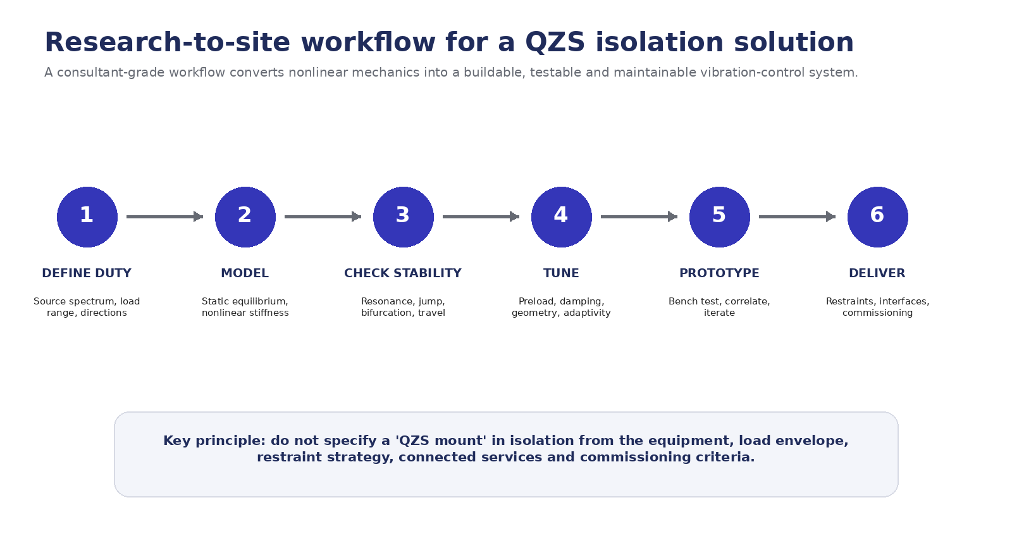
Figure 5. Research-to-site delivery workflow. The workflow translates QZS theory into a project process covering source definition, nonlinear modelling, stability checks, tuning, prototype correlation, interface coordination and commissioning. Original explanatory graphic derived from Jiao et al. (2026).
From Evidence to Engineering Practice
The central contribution of quasi-zero-stiffness isolation is not simply a lower natural frequency. It is a different way of thinking about support stiffness: carry the static load with confidence, then engineer the incremental dynamic stiffness around the operating point. The review shows that this principle can be realised through springs, linkages, cams, magnets, bio-inspired mechanisms, origami and architected materials, and extended from single-axis mounts to complete six-degree-of-freedom platforms (Jiao et al., 2026).
The same evidence also defines the caution. QZS systems are nonlinear, load-sensitive and mechanism-dependent. The best designs therefore combine stiffness synthesis with appropriate damping, wide operating range, robust tolerances, multidirectional modelling and test correlation. Future progress is likely to come from adaptive control, smart materials, topology optimisation, digital twins and more manufacturable meta-structures — but industrial value will depend on durability, standardisation, cost and repeatability as much as theoretical isolation performance (Jiao et al., 2026).
Kinetics Group’s role in this engineering landscape is to bridge research and field implementation: translating source data into isolation criteria, coordinating vibration and acoustic requirements with structural and seismic demands, developing manufacturable solutions, validating performance through simulation and testing, and carrying the design through installation and operational optimisation.
For consultants, contractors and asset owners, the next step is to define the real vibration spectrum, load envelope and transmission paths before selecting the isolation architecture. Early coordination creates room to tune stiffness, damping, travel and interfaces; late vibration correction usually adds complexity, access constraints and cost.
Discuss a low-frequency vibration, HVAC plant isolation, precision-equipment or seismic coordination challenge with Kinetics Group.
Email: info@kineticsgroup.ae | sales@kineticsgroup.ae
Telephone: +971 4 885 7361
Website: www.kineticsgroup.ae
Because true low-frequency isolation is not about making a support weaker — it is about engineering stiffness intelligently.
Reference
Jiao, G., Xu, G. and Wang, S. (2026) ‘Quasi-zero-stiffness vibration isolation: A comprehensive review of design principles and engineering applications’, International Journal of Non-Linear Mechanics, 188, 105388. https://doi.org/10.1016/j.ijnonlinmec.2026.105388
Editorial note: All technical visuals in this article are original explanatory graphics derived from the reviewed mechanisms and reported results. They are positioned beside the sections they are intended to clarify. The HVAC and building-services discussion is an engineering interpretation of the review, not a direct claim that the cited paper experimentally validated QZS systems on commercial HVAC equipment.