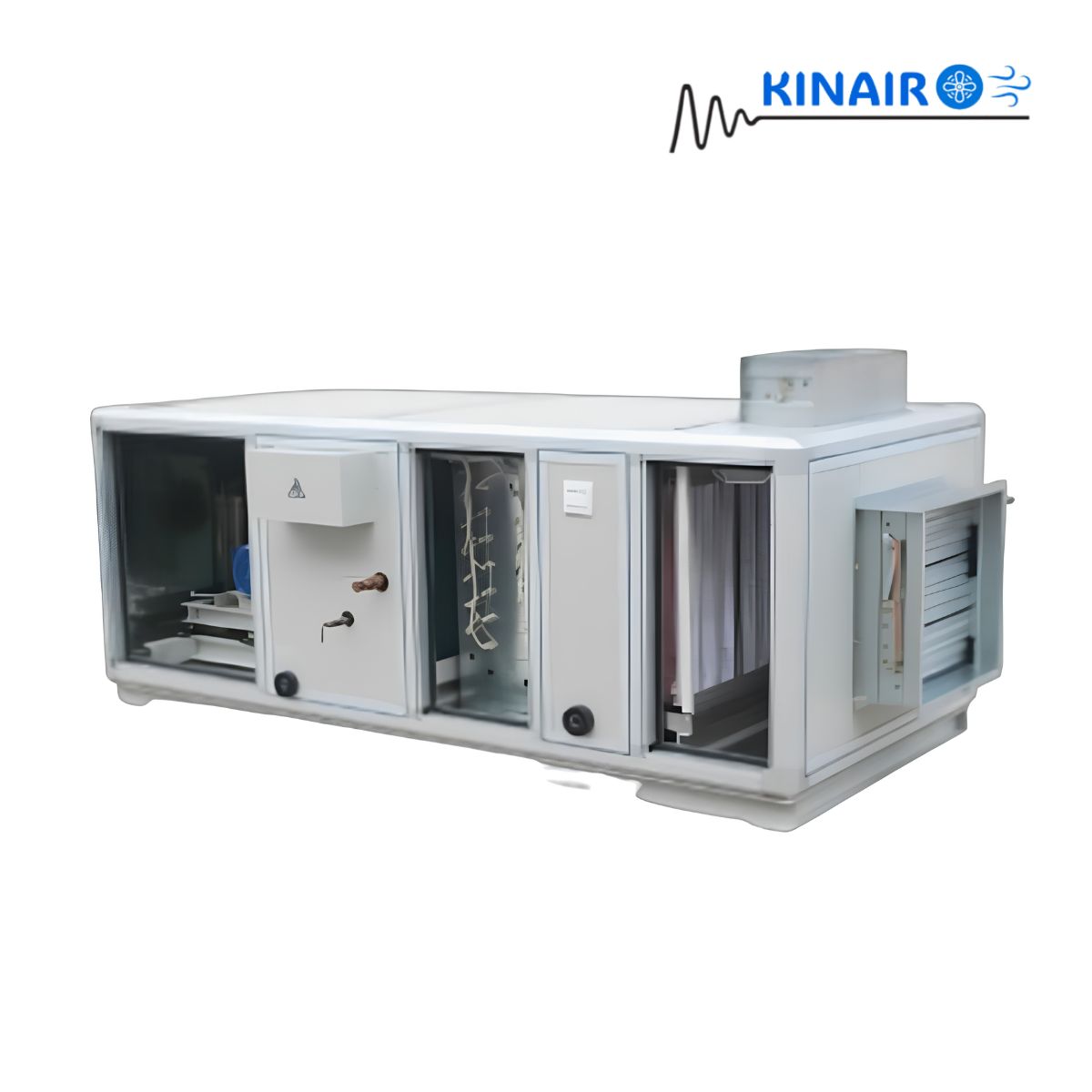
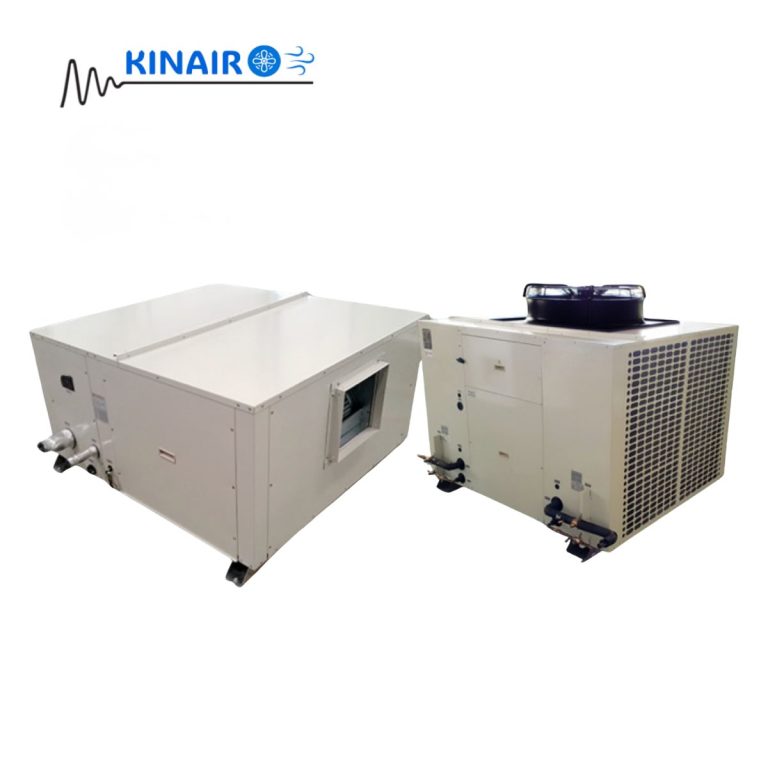
Kinetics Group provides KINAIR Air Handling Units and Fresh Air Handling Units for HVAC projects across the UAE, GCC, Middle East and MENA. The custom AHU and FAHU range covers airflow capacities from 500 CFM to 50,000 CFM and supports chilled-water cooling, DX cooling, heat recovery, dehumidification, ISO 16890 filtration, HEPA filtration and EC fan configurations. Applications include commercial buildings, hospitals, hotels, schools, data centres, industrial facilities and infrastructure projects.
Custom Air Handling Units for HVAC Projects
KINAIR AHU / FAHU units are engineered to meet specific project requirements for air volume, cooling, heat recovery, filtration, resistance, and unit arrangement. Each air handling unit can be customized in terms of dimensions, components, construction options, and configuration, making the range suitable for indoor and outdoor HVAC applications across commercial and industrial building services projects.
What Is the Difference Between an AHU and FAHU?
An Air Handling Unit, or AHU, conditions and circulates air through an HVAC system. Depending on its configuration, an AHU can process recirculated air, outdoor air or a mixture of both.
A Fresh Air Handling Unit, or FAHU, is specifically configured to introduce, filter and condition outdoor air before supplying it to occupied spaces. FAHUs are commonly specified where controlled fresh-air ventilation, building pressurisation, humidity control or enhanced indoor air quality is required.
KINAIR units can be configured as AHUs, FAHUs, treated fresh-air units, chilled-water units or DX air handling units according to the project airflow, cooling, filtration, heat-recovery and control requirements.
Flexible Product Configurations
KINAIR Handling Units are available in multiple configurations, including inline chilled water or DX air handling units, AHUs with energy recovery components, heat recovery wheel systems, plate heat exchangers, heat pipe heat recovery, horseshoe heat pipe dehumidification systems, integrated control systems, plug-and-play solutions, and AHUs incorporating indirect evaporative cooling with intelligent control functions. Units can also be designed according to the requirements stated in DIN 1946-4 standard where applicable.
Robust Construction and Insulated Panels
The unit frame is constructed from extruded aluminum profiles, with anodized or mill finish options. The frame uses Aluminum Alloy 6063, T6 temper, providing resistance to stress, corrosion, and cracking. The enclosure is made from double-wall sandwiched panels with polyurethane foam or rockwool insulation to support thermal insulation, sound insulation, reduced vibration, and high static pressure operation. Access-side panels can be removed for easier access to internal components.
Cooling Coils, Drainage, and Heat Transfer Options
KINAIR AHU / FAHU units can be supplied with chilled water, hot water, direct expansion, condenser, and AHRI 410 certified coil configurations. Heat transfer coils are available with variable fin spacing, copper tube thickness options, galvanized or stainless-steel casing, and protective coating options for corrosive atmospheres. The coil section includes an insulated stainless-steel drain pan, multi-sloped toward the drain connection, supporting drainage, hygiene, and indoor air quality.
Advanced Air Filtration for Indoor Air Quality
The air filtration range includes prefilters, medium and fine filters, EPA and HEPA filters, gas phase filters, UV-C filtration, and bi-polar ionizers. Filters are available in different media, depths, frames, and efficiency grades, depending on application requirements. The catalogue notes that all filters are in accordance with the latest ISO 16890 standards, with filter grades ranging from G2–G4, M5–F9, and H10–H14 depending on filter type.
Fan, Motor, and EC Fan Options
KINAIR AHU / FAHU units support DIDW blowers, plenum fans, motors, and EC fan arrangements. DIDW centrifugal belt-driven blowers are available in forward-curve and backward-curve options for low, medium, and high-pressure applications. Plenum fans are available in direct-driven and belt-driven types. Motors are TEFC, foot-mounted, continuous duty, IP55 protected, Class F insulated, and supplied as IE2 efficiency motors as standard, with IE3 and Class H motors available on request. EC fans include high-efficiency backward-curved impellers, external rotor EC motors, integrated variable speed drive, PI control with sensor input, and MODBUS HLI connection over RS485.
Selection Software and Project Support
KINAIR AHU selection software helps consultants and engineers select suitable unit configurations, construction options, sheet thickness, insulation, and component arrangements. It can generate 3D visualization, detailed technical reports, fan curves, psychrometric curves, and dimensional drawings in PDF and DWG formats, supporting MEP coordination and project documentation.